


UK gambling winnings tax generally does not apply to you as a player, but US gambling winnings are generally taxable and can create obligations for British visitors. The key distinction is which country can tax you, rather than whether you played online, at a casino or at a racetrack.
This guide separates the UK position from the US federal and state rules that often cause confusion. It covers personal gambling winnings, reporting, losses and record-keeping, with particular care around cross-border play. It is general information, not personalised tax advice.
How gambling winnings tax works in the UK
You normally do not pay UK Income Tax or Capital Gains Tax on your personal gambling winnings. That treatment generally covers betting, casino games, bingo, poker and lottery prizes, whether you win occasionally or regularly.
For a UK player, a successful roulette spin, a winning horse racing bet and an online slots payout generally receive the same treatment. The size of the win does not, by itself, create a UK tax bill. There is no ordinary player allowance that you use up before gambling winnings become taxable.
HMRC distinguishes your winnings from the taxes paid by gambling operators. A bookmaker or casino can have gambling duty obligations without you having to declare a personal win as taxable income.
The phrase gambling winnings tax can therefore be misleading when US advice appears in a UK search result. References to the IRS, federal withholding, state income tax and Form W-2G describe American rules, not the normal position for someone gambling in the UK.
Do you need to tell HMRC about a win?
You generally do not include ordinary personal gambling winnings on a Self Assessment tax return as taxable income. However, keep evidence of a substantial payout so you can explain where the money came from if your bank, mortgage provider or HMRC asks.
A source-of-funds check is different from a tax assessment. A bank asking for a casino statement does not mean your withdrawal has become taxable. Provide accurate records rather than assuming that a tax-free payment needs no supporting evidence.
Which payments are winnings and which are taxable income?
A personal gambling win is different from payment for work, services or a gambling-related business. Interest or investment returns earned after you receive your winnings can also be taxable, even though the original prize was not.
When considering gambling winnings tax, identify the actual source of each payment. A poker tournament prize and a fee for promoting that tournament are separate types of receipt. Calling both payments gambling income can lead to the wrong answer.
| Payment or situation | Usual UK treatment | What to check |
|---|---|---|
| Personal casino, bingo or sports betting win | Generally not taxable for the player | Keep the payout and account records |
| Personal lottery prize | Generally not taxable when received | Separate the prize from later income it earns |
| Interest earned on deposited winnings | May be taxable under savings rules | Your allowances and other savings income |
| Sponsorship, appearance fees or paid betting tips | May be taxable earnings or business income | The contract and the service provided |
| Gambling losses | Normally no personal tax deduction | Do not offset them against salary |
| Winnings connected with the US | US rules may apply separately | Residence, game, withholding and treaty treatment |
Interest, investments and gifts after a win
If you deposit winnings in a savings account, any interest is assessed under the normal savings tax rules. If you buy investments, later dividends or gains may be taxable under the rules for those investments. Neither changes the original treatment of the gambling payout.
Giving winnings to someone else can raise separate estate-planning and Inheritance Tax questions. A large gift does not automatically create an immediate tax charge, but it should not be treated as consequence-free simply because the money originally came from a tax-free win.
Do professional gamblers pay UK tax?
Gambling frequently, using skill or relying on winnings for your living does not usually make your own UK betting profits taxable. Separate commercial activities, such as sponsorship or selling advice, can still create taxable income.
The UK approach differs from the US treatment of professional gambling. Describing yourself as a professional player does not automatically mean that HMRC treats your personal bets as a taxable trade.
Someone using arbitrage betting still needs to distinguish their own betting returns from money earned by providing a paid service. A methodical approach to placing bets does not, on its own, settle every tax question surrounding the activity.
Get advice if you receive sponsorship, manage other people’s money, run a gambling operation or earn fees alongside your winnings. These arrangements require more careful analysis than a straightforward gambling winnings tax question about your own casino withdrawal.
Can UK players deduct gambling losses?
You normally cannot deduct personal gambling losses from your salary, savings income or other taxable earnings. The usual UK treatment works in both directions: personal wins are generally outside tax, and personal losses do not provide tax relief.
Keep a separate record of your actual profit or loss for budgeting. Tax-free winnings do not mean profitable gambling, and a large withdrawal can still be smaller than the total amount you deposited.
Why US gambling winnings tax rules are different
For US taxpayers, gambling winnings are generally taxable income at federal level, and state tax can apply too. A casino’s reporting threshold does not create a tax-free allowance for the player.
The IRS generally expects US taxpayers to report taxable gambling winnings even when no reporting form arrives. That includes a $10 sports bet win or a $50 pull-tab win, subject to the applicable accounting and reporting rules. Lottery tickets, scratch-offs and office pools can also produce taxable winnings.
This is why gambling winnings tax advice must identify its audience. Instructions aimed at a US resident should not be presented as universal rules for UK readers, and rules for US residents do not necessarily apply unchanged to British visitors.
How winnings affect a US return
For a simplified example, $5,000 of reportable slot winnings plus $50,000 of employment income gives $55,000 before relevant adjustments and deductions. That figure is not automatically your final taxable income or your tax bill.
A $5,000 slot win should not be described as below the slot reporting threshold. More broadly, reporting thresholds determine when a payer must issue information to the IRS, not whether the underlying winnings count as income.
Your overall US liability depends on your filing position, other income, allowable deductions and applicable rates. The percentage withheld at the casino is an advance payment, not necessarily the final amount owed.
US reporting forms and withholding in 2026
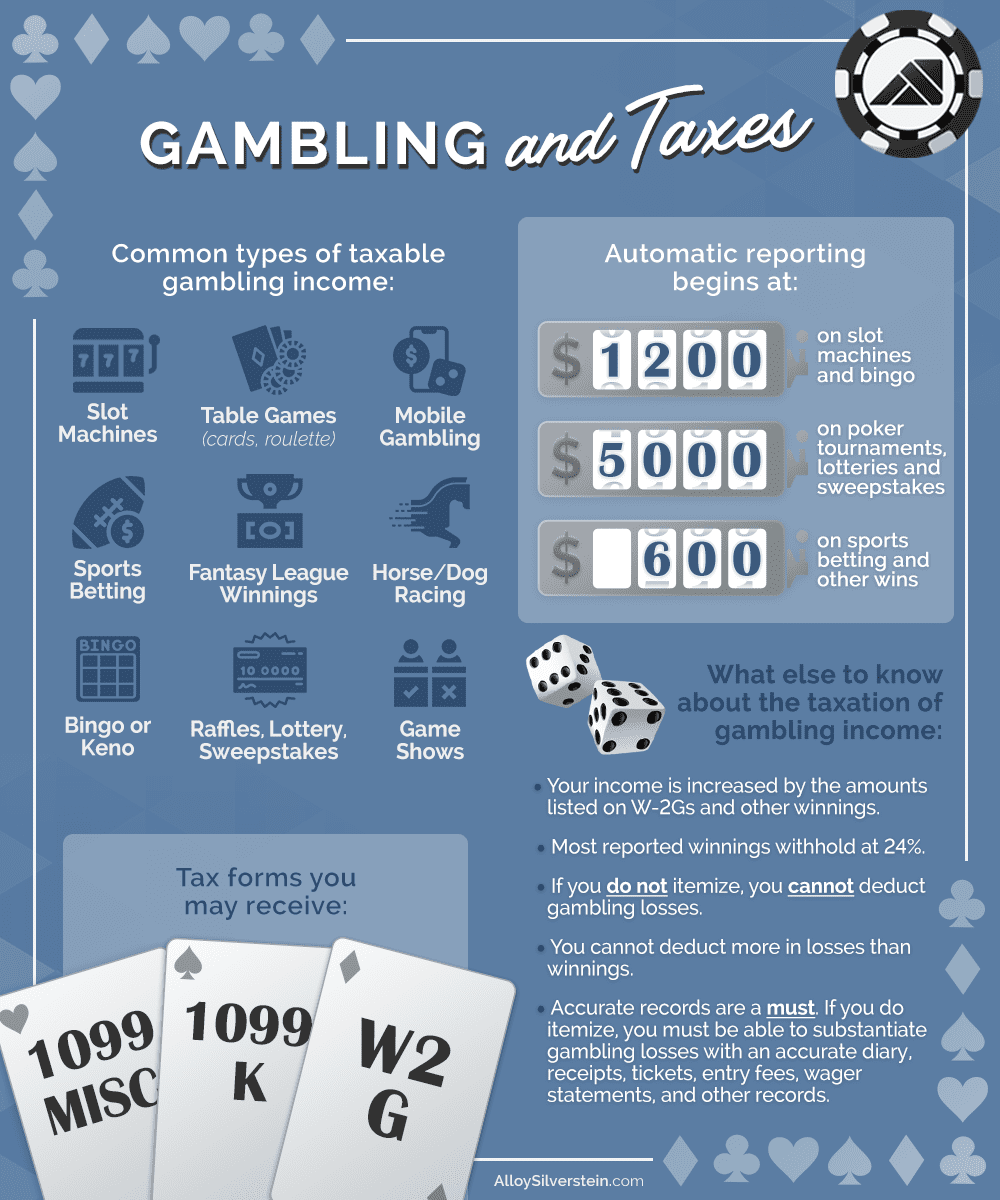
Form W-2G records certain gambling winnings and any tax withheld for US reporting purposes. Reporting and withholding rules depend on the game, payment and taxpayer status, so a single threshold or withholding percentage cannot describe every payout.
Older gambling winnings tax guides often list fixed thresholds without explaining that rules can change. For a payment received in 2026, use the applicable IRS instructions and the payer’s current reporting guidance rather than relying on an old threshold list.
What to check on a reporting form
- Confirm that your name, taxpayer identification details and payment information are correct.
- Check which game or event generated the winnings.
- Check whether the applicable calculation deducts the wager or tournament buy-in.
- Compare the reported amount with your tickets, account statements and payout receipts.
- Identify federal and state withholding separately.
- Ask the payer to correct errors and keep the correspondence.
Horse racing reporting can involve a payout-to-wager condition, including a 300-times test. Slot machines, bingo, keno and poker tournaments have their own reporting rules. Do not assume that the calculation for one type of gambling applies to another.
Where regular federal gambling withholding applies to a US taxpayer, the rate is generally 24%, rather than 25%. Backup withholding and payments to foreign recipients involve separate considerations. A payer may request a Social Security Number or other appropriate taxpayer documentation.
Blackjack, craps, baccarat and roulette
Ordinary winnings from blackjack, craps, baccarat and roulette generally do not trigger Form W-2G in the same way as reportable slot or tournament payouts. For US taxpayers, the absence of that form does not make the winnings tax-free.
Casinos may also request identification or make other regulatory reports. Those processes are separate from deciding whether a particular payment requires Form W-2G. Keep your own records rather than using the presence or absence of a form as your only guide.
Can US taxpayers deduct gambling losses?
Casual US gamblers generally need to itemise to claim an allowable gambling-loss deduction. In 2026, the federal deduction is generally limited to 90% of qualifying wagering losses and cannot exceed gambling winnings.
This restriction makes older advice saying that losses always offset winnings pound for pound, or dollar for dollar, unreliable. The gambling winnings tax calculation can leave taxable gambling income even where your cash results show that you broke even.
For example, $10,000 of winnings and $10,000 of qualifying losses generally produce a maximum loss deduction of $9,000 under the 90% restriction. The remaining $1,000 is not offset by that deduction. Your actual return still depends on your circumstances and the applicable filing rules.
With $10,000 of winnings and $12,000 of qualifying losses, 90% of the losses is $10,800, but the winnings cap limits the deduction to $10,000. The extra $2,000 of actual losses does not create a deduction against salary.
Professional US gamblers can have different reporting requirements and business-related issues, including the treatment of travel, lodging, admission fees and training expenses. These costs are not automatically deductible without restriction. Classification depends on the facts, and the wagering-loss rules require specialist attention.
British visitors, US winnings and state taxes
A British visitor can face US tax documentation or withholding even though personal gambling winnings are normally tax-free in the UK. Treaty provisions and game-specific exemptions may affect the result, so establish your tax residence and eligibility before assuming a deduction is correct.
US-source gambling winnings paid to a nonresident can face 30% federal withholding unless an exemption or treaty relief applies. The US-UK tax treaty can provide relief for qualifying UK residents, but citizenship alone is not enough to establish eligibility.
Ask the payer what documentation it needs to apply treaty treatment, potentially including Form W-8BEN and appropriate taxpayer identification. Foreign recipients may receive Form 1042-S rather than Form W-2G. If tax has already been withheld, a US filing may be needed to seek a refund.
Some nonresident winnings from blackjack, baccarat, craps, roulette and big-6 wheel receive specific US federal treatment. Do not extend that treatment automatically to poker, slots or sports betting. Cross-border gambling winnings tax needs an answer based on your actual game and residence.
Federal relief does not settle every state question
California generally taxes gambling winnings as ordinary income, although exceptions apply, including California Lottery winnings. Nevada and Florida have no individual state income tax. These differences matter when assessing a US payout.
The state where you win and, for US residents, the state where you live can both be relevant. State treatment does not necessarily follow federal treaty relief or federal deductions. Check the particular state’s rules rather than assuming that no federal tax means no state liability.
Records to keep and steps after a substantial win
Keep records showing what you won, where it came from and whether any tax was withheld. Good evidence helps you answer bank checks in the UK and supports reporting, deductions or refund claims where overseas tax applies.
You do not need to treat every UK win as taxable to justify keeping a gambling diary. It is useful evidence of the source of your money and a practical way to measure losses accurately.
- Save the payout confirmation, winning ticket or tournament result before closing your account.
- Download deposits, wagers, winnings and withdrawals rather than relying on a single bank transfer.
- Record the date, game, amount won or lost, and the establishment’s name and address.
- Keep machine numbers or table details where available, plus relevant poker participant information.
- For keno, retain tickets and cash register receipts. Keep buy-in receipts for tournaments.
- Save every tax form and any explanation of withholding.
- Get qualified advice when a foreign payout, disputed withholding or commercial arrangement makes the position unclear.
A withdrawal is not always the same as a win. It may include money you originally deposited, several separate payouts or funds already sitting in your account. Evidence that separates these amounts is more useful than a screenshot showing only your balance.
If you discover an error on a US return, seek advice about correcting it. Unreported taxable income can result in back taxes, interest and penalties. Deliberate tax evasion can lead to criminal prosecution, but an innocent mistake is not automatically tax evasion.
Keep tax planning separate from gambling decisions
Do not place further bets to try to reduce a gambling winnings tax bill. Losses can exceed any possible tax benefit, and UK personal gambling losses normally provide no deduction at all.
For casino gambling and sports betting, you must be 18 or over. Use appropriate licensed services, set affordable limits and never chase losses. Our guide to problem gambling explains support options if gambling is affecting your finances or wellbeing.
Frequently asked questions about gambling winnings tax
Most UK players do not owe tax on personal gambling winnings, but overseas obligations and income earned afterwards need separate consideration. These answers address common UK questions without applying American rules to every reader.
Do I pay tax on gambling winnings in the UK?
Generally, no. Personal betting, casino, bingo, poker and lottery winnings are normally free from UK Income Tax and Capital Gains Tax. Payments for services connected with gambling can be taxable.
Do I have to declare a large casino win to HMRC?
You generally do not declare an ordinary personal casino win as taxable income on Self Assessment. Keep proof of the payout, particularly if a bank or HMRC later asks you to explain the source of your funds.
Are online gambling winnings taxable?
The online format does not normally change the UK treatment of personal winnings. Foreign tax obligations may still matter depending on your residence and the transaction, so an overseas website should not be your only basis for deciding the answer.
Do professional poker players pay tax in the UK?
Their own poker winnings are generally not taxable simply because they play professionally. Sponsorship, appearance fees, coaching and other paid services can create separate taxable income.
Can I claim gambling losses against my wages?
UK players normally cannot deduct personal gambling losses from wages. US deductions follow different rules, including itemisation for casual gamblers, the winnings cap and the 90% restriction applicable in 2026.
Will I pay tax if I win in Las Vegas?
Possibly, depending on your tax residence, game and treaty eligibility. Nevada has no individual state income tax, but US federal withholding and documentation can still apply. Qualifying UK residents should check treaty relief before accepting withholding as their final liability.


