


Betting exchanges are online marketplaces where you bet against other customers, either backing an outcome to happen or laying it not to happen. You can accept available odds or request your own price, but a bet only takes effect when another participant matches it.
For UK customers in 2026, the main attractions are flexible pricing, lay betting and the ability to manage positions before an event finishes. These features do not guarantee better returns. Commission, available money, settlement rules and the risk of losing your stake or lay liability all matter.
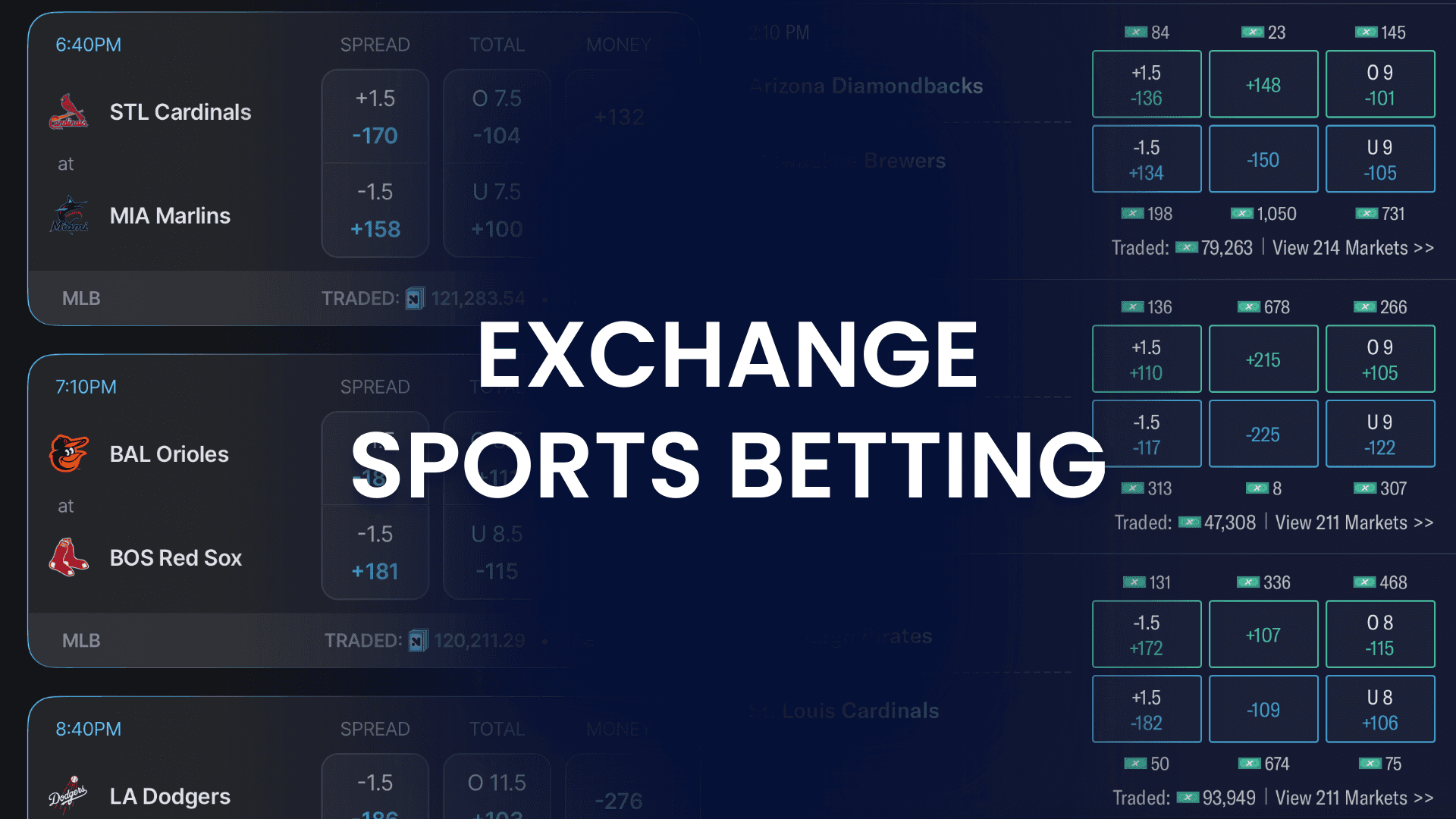
How betting exchanges work: backing and laying
Betting exchanges match customers who want opposing sides of the same wager. A back bet wins if your selection succeeds, while a lay bet wins if that selection does not succeed under the market’s settlement rules.
The exchange provides the platform and settles matched bets. Rather than building a conventional bookmaker margin into a single set of offered prices, it generally charges commission on net market winnings. The difference between available back and lay prices is another practical cost to consider.
Backing Manchester United to win
Consider Tottenham against Manchester United in a standard football match-result market. If you back Manchester United at decimal odds of 2.5 with £10, a winning bet returns £25. That includes your £10 stake and £15 profit before commission.
If Manchester United draw or lose, your £10 back stake loses. Check the market rules because a standard match-result bet usually covers normal time plus stoppage time, rather than extra time or penalties.
Laying Manchester United to win
If you lay Manchester United at 2.5 for a £10 lay stake, you accept the opposing customer’s £10 back bet. You win £10 before commission if United draw or lose, but you lose £15 if United win.
The £15 is your liability, meaning the amount you risk. On betting exchanges, the lay stake and the maximum possible loss are different figures, so reading the liability field is essential before confirming an order.
Lay liability = lay stake × (decimal odds − 1). In this example, £10 × (2.5 − 1) = £15. Higher lay odds create a larger liability for the same lay stake.
Available odds and requested odds
You can accept money already offered at an available price or submit an order at different odds. Requesting a price does not make it available immediately. Another customer must accept the opposing side before that part of your order becomes a bet.
Prices move as participants change their offers and new information arrives. This creates trading opportunities, but it also means a price you saw moments earlier may no longer be available when you submit your order.
Betting exchanges versus traditional bookmakers
Betting exchanges let you back and lay against other customers, while traditional bookmakers generally take the other side of your back bet. Neither format always offers the better deal, so compare the actual available odds, charges and settlement terms.
| Feature | Betting exchange | Traditional bookmaker |
|---|---|---|
| Who sets prices? | Participants submit back and lay offers. | The bookmaker sets its offered odds. |
| Bet types | You can back or lay an available selection. | You generally back offered outcomes. |
| Pricing cost | Commission and the back-to-lay spread matter. | A margin is incorporated into the odds. |
| Stake availability | Depends on liquidity, balance and platform rules. | Depends on the bookmaker’s acceptance and limits. |
| Price visibility | Available amounts may be displayed at several prices. | You usually see an offered price rather than an order book. |
| Closing a position | An opposing matched bet can reduce exposure. | Cash-out may be offered on eligible bets. |
| Main execution risk | Your order may remain unmatched or match only partly. | Your requested stake or price may not be accepted. |
A bookmaker’s margin is often called the overround or vigorish. It is built into the combined prices offered across a market, rather than appearing as a separate commission deduction. It supports the bookmaker’s expected return, but does not ensure a profit on every event.
Bookmakers may restrict stakes or close accounts under their terms, including accounts they consider commercially unattractive. Betting exchanges generally benefit from active participants adding liquidity, but that does not mean accounts are unrestricted. Verification, safer-gambling controls, exposure limits and other account rules still apply.
An exchange order book can show money available at different prices, depending on the interface. It does not reveal every participant’s intentions or guarantee that displayed offers will stay available. Treat market depth as useful information, rather than certainty about future prices.
Compare like-for-like markets too. Our explanation of Each Way Extra describes a bookmaker product whose place terms need separate assessment. A simple exchange win price does not reproduce every feature of an each-way offer.
Commission and the true value of exchange odds
Betting exchanges generally deduct commission from your net winnings in a settled market, rather than from your returned stake. To judge value, compare the profit after commission with the profit available from the same bet elsewhere.
The commonly quoted commission range of 1-5% is a useful starting point, not a universal tariff. Rates can depend on the operator, account terms, location, market and promotions. Additional charges may apply to certain accounts or activities, so inspect the full fee schedule.
Compare 1.9 with 2.0 properly
Suppose a bookmaker offers 1.9 and an exchange offers 2.0 on the same selection. At a £10 stake, the bookmaker’s winning profit is £9. At the exchange, the gross profit is £10, or £9.80 after an illustrative 2% commission deduction.
In that example, the exchange price is better after commission. However, a smaller difference in headline odds could disappear once charges are included. Betting exchanges are not automatically cheaper simply because the displayed decimal price is higher.
For a single winning back bet, a useful comparison is: effective decimal odds = 1 + ((exchange odds − 1) × (1 − commission rate)). This simplified calculation assumes the stated commission applies to that profit and no other charges affect it.
If you have several bets in one market, commission normally depends on the market’s overall result for your account. Do not calculate each winning leg in isolation and assume that gives the final charge. Check how the operator handles netting and settlement.
Liquidity, unmatched bets and in-play delays
Liquidity is the money available to match bets at particular prices on betting exchanges. Low liquidity can leave an order unmatched, produce only a partial match or force you to accept a worse price for the remaining amount.
Popular football matches and major horse races can attract substantial activity, while niche markets or events far from their start time may be thinner. Total money previously matched is not the same as money available for your next bet at your chosen odds.
Understand the three order states
- Matched: Another participant has accepted your order, creating a bet under the market rules.
- Partially matched: Only some of your requested stake has been accepted. The remainder is still an outstanding order.
- Unmatched: No opposing participant has accepted that portion of the order.
You can generally cancel an unmatched portion while the market allows it. You cannot simply cancel a matched bet because you have changed your mind. Placing an opposing bet changes your exposure, but requires another match and may involve less favourable odds.
Check what happens at the start
Betting exchanges may offer settings that cancel an unmatched order at the start or keep it active when a market turns in-play. Availability and terminology vary. Read the selected setting because an offer left active can be matched after circumstances have changed.
In-play betting introduces further uncertainty. Broadcasts may be delayed, bet placement can include an enforced delay, and markets can suspend around goals, penalties or other significant incidents. You should never assume you can act on a television picture before the price changes.
Automated bots and large orders can move prices quickly. A sudden movement is not, by itself, proof of manipulation. Other participants may have faster information or may simply be adjusting their positions, so avoid treating price movement as a dependable betting signal.
Comparing UK betting exchanges in 2026
Betfair, Smarkets and Matchbook are useful starting points when comparing betting exchanges for UK use. Choose by the available price and depth in your preferred markets, then assess fees, rules and usability rather than relying on a universal ranking.
The operator descriptions below explain what to compare, not the results of a live platform test. Current commission, promotions and account eligibility should be confirmed directly before you deposit. A platform with lower advertised fees can still produce a worse overall result if its available prices are weaker.
Betfair: liquidity and market choice
Betfair is a long-established exchange associated with substantial liquidity and broad market coverage. Its available markets include major sports and some political events. Market depth is a key reason to compare it, particularly if you need more money available at a specific price.
That does not mean a substantial wager will always match at your desired odds. Inspect the actual market and the amount available. Betfair’s in-play features, cash-out options and mobile app can be convenient, but their availability depends on the market and operating conditions.
Its commission documentation can involve a market base rate and a discount rate, although the arrangement applying to your account may differ. Check your displayed terms and any additional charges rather than assuming one headline percentage applies to everyone.
Smarkets: fees and interface
Smarkets is another option for customers comparing pricing and a straightforward back-and-lay interface. Its standard 2% commission figure is commonly associated with the service, but you should confirm the current rate and the conditions applying to your account.
A 1% Pro Tier figure should not be treated as an automatically available alternative to the standard rate. Tier eligibility and charging methods need checking in the current terms. A lower headline percentage is not sufficient evidence that an account arrangement will cost you less overall.
When assessing Smarkets, look at how clearly the bet slip displays liability, matched amounts and outstanding orders. Check support arrangements and market availability yourself. A clean interface is useful, but it cannot compensate for insufficient liquidity in the event you want to bet on.
Matchbook: market-specific value
Matchbook offers another exchange option, with coverage that includes football, horse racing and NFL. Compare its available odds and money at the time you intend to bet, rather than assuming the same liquidity across every sport.
Quoted Matchbook commission figures include 2% or 4%, with charges described as applying to net winnings rather than losing market results. These figures should not be read as a confirmed tariff for every UK customer in 2026. Your applicable rate and charging basis need verification.
Selected-sport promotions have included 0% commission periods. Treat these as conditional offers, not permanent pricing. Check eligibility, the qualifying markets and the end of the promotional period before including any saving in your calculations.
Spreadex: a different type of product
Spreadex combines traditional fixed-odds betting with sports spread betting. That makes it relevant to a wider comparison of betting products, but it should not be presented as interchangeable with a peer-to-peer exchange.
Sports spread betting has a different risk structure because the amount won or lost depends on how far the result moves beyond the quoted spread. Losses can exceed an initial stake or deposit depending on the product and protections. Understand those terms separately from exchange lay liability.
How to place an exchange bet carefully
Before using betting exchanges, choose the correct market, calculate your maximum loss and check how much of your order can match. After placing it, confirm its status rather than assuming that submitting the bet slip completed the bet.
- Check eligibility and regulation. You must be 18 or over. For customers in Great Britain, verify the operator and relevant permission on the Gambling Commission register.
- Set an affordable budget. Decide what you can lose without affecting essential spending and use available deposit limits.
- Read the market rules. Confirm the event, selection, settlement period and treatment of abandonment, withdrawals or other relevant changes.
- Select back or lay. Read the labels carefully rather than relying only on interface colours.
- Enter odds and stake. For a lay bet, inspect the liability separately and make sure you understand the maximum loss.
- Check the available amount. If there is insufficient money at your requested price, expect a partial match or an unmatched order.
- Review the confirmation. Inspect matched odds, matched stake and any remaining order, including its in-play setting.
- Check settlement. Review the market result and commission deduction, and keep a record of your overall spending.
If you follow international football, our guide to World Cup betting provides related context. The same exchange checks still apply to tournament matches, including whether you are betting on a normal-time result or qualification.
Trading and hedging without guaranteed-profit claims
Trading on betting exchanges means placing back and lay bets at different prices to change your exposure. An opposing bet can reduce risk or establish a positive position across outcomes only when the required orders match and the calculations include charges.
For example, a customer might back a selection and later lay it after the odds shorten. The correct opposing stake depends on both prices and the intended outcome. Using the same stake on both bets does not necessarily create equal profit or loss across every result.
The difficulty is execution. Odds may move against you, liquidity may disappear, or the market may suspend before your second bet matches. Until the position is properly offset, the original exposure still exists.
Cash-out is a convenience feature rather than a promise that you can leave a bet whenever you want. It depends on market conditions and can become unavailable. Check completed bets after using it because a displayed estimate is not the same as a confirmed final position.
Some customers compare prices across platforms for arbitrage betting. This adds practical risks, including different settlement rules, changing prices and one side failing to match. Do not treat a theoretical price difference as risk-free income.
Choosing safely and managing your gambling
Betting exchanges are gambling products, and the ability to lay or trade does not make them a reliable source of income. Only use money you can afford to lose, and stop if betting affects your finances, relationships or wellbeing.
For Great Britain, check that the operator holds the appropriate Gambling Commission licence for the activity you intend to use. A familiar brand name alone is not a substitute for verifying the licensed business and website. Licensing provides requirements and protections, not protection against ordinary gambling losses.
Compare the practical controls available alongside odds and fees. Useful checks include deposit limits, time-outs, self-exclusion, account history, withdrawal procedures and access to customer support. Complete required identity checks through the operator’s official process.
Do not increase stakes to recover a loss or keep adding money to support an unplanned lay liability. If you feel pressure to continue, take a break and consider self-exclusion through GAMSTOP for participating online services in Great Britain.
Our guide to problem gambling explains further warning signs and support options. You can also seek confidential support from GamCare. Asking for help does not depend on reaching a particular level of loss.
Frequently asked questions about betting exchanges
Betting exchanges give you control over requested prices and the option to lay selections, but every matched bet carries financial risk. These answers cover common UK questions about legality, commission and how exchange orders work.
Are betting exchanges legal in the UK?
Yes, licensed exchange betting is legal for eligible adults aged 18 and over. In Great Britain, verify the operator’s relevant Gambling Commission licence. Eligibility and local requirements should be checked rather than assumed from a website’s availability.
What is the difference between a back bet and a lay bet?
A back bet wins if your selection succeeds. A lay bet wins if it does not succeed under the market rules. Your lay liability is the lay stake multiplied by the decimal odds minus one, and it can exceed the lay stake.
How do I set my own odds on a betting exchange?
Enter your requested price and stake as a back or lay order. Another participant must accept the opposing side for it to match. If nobody accepts, the order stays unmatched and may need cancelling before circumstances change.
How much commission do betting exchanges charge?
A commonly quoted range is 1-5% of net market winnings, but rates and additional charges vary. Check your actual account terms. Compare after-commission profit rather than assuming the exchange with the lowest headline fee offers the best value.
Can I use a betting exchange for in-play betting?
Yes, many exchange markets support in-play betting. Placement delays, market suspensions, broadcast delays and changing liquidity can affect execution. A price displayed on screen is not guaranteed to remain available when your order reaches the market.
Which betting exchange is best for UK customers in 2026?
There is no single best option for every customer. Compare Betfair, Smarkets and Matchbook using the markets you actually need, the available money at your stake size, your account’s commission and the clarity of the platform’s controls.


